
How these parts work together, and why, is explained in What happens during a request.
Objects of a request
| Object | Class | Lifetime | Get it with |
|---|---|---|---|
| Application | WebApplication |
One per Wicket filter, for the life of the web application. |
Application.get(), Component.getApplication()
|
| Session |
WebSession or your subclass |
One per user, created by Application.newSession(). |
Session.get(), Component.getSession()
|
| Request cycle | RequestCycle |
One per request. |
RequestCycle.get(), Component.getRequestCycle()
|
| Request |
ServletWebRequest (a WebRequest, a Request) |
One per request. |
RequestCycle.get().getRequest(), Component.getRequest()
|
| Response |
ServletWebResponse (a WebResponse, a Response) |
One per request; can be swapped during rendering. |
RequestCycle.get().getResponse(), Component.getResponse()
|
The static get() methods read a thread-local value that Wicket sets while it serves the request. Outside a request, for example in a background thread, RequestCycle.get() returns null and Application.get() throws a WicketRuntimeException. Application.exists() and Session.exists() tell you whether one is bound to the thread.
Servlet request and response
Request.getContainerRequest() and Response.getContainerResponse() return the objects of the servlet container:
var servletRequest = (HttpServletRequest) getRequest().getContainerRequest();
var servletResponse = (HttpServletResponse) getResponse().getContainerResponse();
String clientIp = servletRequest.getRemoteAddr();
Commonly used methods of the Wicket wrappers:
| Class | Method | Returns |
|---|---|---|
Request |
getUrl() |
The URL relative to the Wicket filter. |
Request |
getClientUrl() |
The URL as the browser sees it, relative to the filter. |
Request |
getRequestParameters() |
Query and POST parameters together. |
Request |
getQueryParameters(), getPostParameters()
|
One kind of parameters. |
Request |
getLocale(), getCharset()
|
Locale and character set of the request. |
Request |
getContextPath(), getFilterPath()
|
The context path and the filter path. |
WebRequest |
getHeader(name), getHeaders(name), getDateHeader(name)
|
Request headers. |
WebRequest |
getCookie(name), getCookies()
|
Cookies. |
WebRequest |
isAjax() |
Whether Wicket’s Ajax engine sent the request. |
Response |
write(CharSequence), write(byte[])
|
Writes to the response. |
Response |
encodeURL(CharSequence) |
Adds the session id to a URL when cookies are off. |
WebResponse |
setHeader(), addHeader(), setContentType(), setStatus()
|
Sets headers and status. |
WebResponse |
addCookie(), clearCookie()
|
Sets or removes a cookie. |
WebResponse |
sendRedirect(url), sendError(code, message)
|
Redirects or sends an error. |
WebResponse |
disableCaching(), enableCaching(duration, scope)
|
Sets cache headers. |
Steps of a request
WicketFilter receives every request mapped to it and asks the application for a request cycle. RequestCycle.processRequestAndDetach() then runs these steps:
| Step | What happens | Hooks called |
|---|---|---|
| 1. Create |
Application.createRequestCycle(request, response) builds the cycle with the IRequestCycleProvider set by setRequestCycleProvider(). |
|
| 2. Begin | The cycle binds itself to the thread. |
IRequestCycleListener.onBeginRequest(), then RequestCycle.onBeginRequest()
|
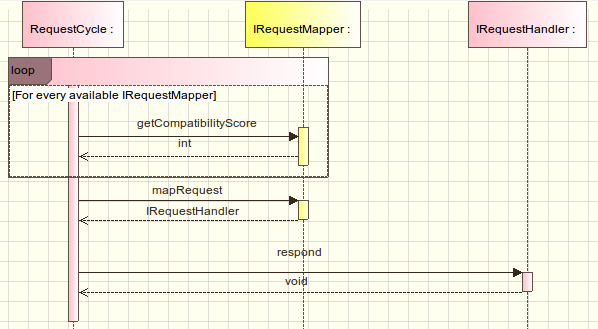
| 3. Resolve | The root request mapper (Application.getRootRequestMapper()) maps the request to an IRequestHandler. If no mapper matches, the filter passes the request on to the rest of the filter chain, so the container can serve it. |
|
| 4. Execute | The handler’s respond() runs. If it schedules another handler, that one runs next, until none is left. |
onRequestHandlerResolved() before and onRequestHandlerExecuted() after each handler; onRequestHandlerScheduled() when one is scheduled |
| 5. Handle an exception | When a step throws, the listeners can return a handler; otherwise the IExceptionMapper from getExceptionMapperProvider() maps the exception to one. Wicket retries up to getRequestCycleSettings().getExceptionRetryCount() times (default 10) if handling fails again. |
onException(), then onExceptionRequestHandlerResolved()
|
| 6. End | Runs also after an exception. |
IRequestCycleListener.onEndRequest(), then RequestCycle.onEndRequest()
|
| 7. Detach | Every executed handler is detached; a page handler detaches the page and its components. Then the session detaches and the request logger records the request. |
RequestCycle.onDetach(), IRequestCycleListener.onDetach()
|
RequestCycle methods
| Method | Description |
|---|---|
get() |
The request cycle bound to the current thread. |
getRequest(), getResponse(), getOriginalResponse()
|
The request, the current response, and the response before any swap. |
setResponse(Response) |
Replaces the response, returns the old one. Components use this to render into a buffer. |
setResponsePage(...) |
Schedules a page to render after the current handler, by class, class and parameters, or instance. Component.setResponsePage() delegates here. |
urlFor(...) |
The URL of a page class, a resource reference or a request handler, as a CharSequence. |
mapUrlFor(...) |
The same, as a Url object. |
scheduleRequestHandlerAfterCurrent(IRequestHandler) |
Runs a handler after the current one. |
replaceAllRequestHandlers(IRequestHandler) |
Stops the current handler and runs this one instead. |
getActiveRequestHandler(), getRequestHandlerScheduledAfterCurrent()
|
The handler running now and the one that runs next. |
find(Class) |
The active or scheduled handler of a type, as an Optional. find(AjaxRequestTarget.class) tells whether this is an Ajax request. |
setMetaData(key, value), getMetaData(key)
|
Data that lives for this request only. |
getStartTime() |
When the cycle started, in milliseconds. |
getListeners() |
The listeners of this cycle. |
Override onBeginRequest(), onEndRequest() and onDetach() in a subclass to run code at those moments. Install the subclass with a provider, because createRequestCycle() is final:
@Override
protected void init() {
    super.init();
    setRequestCycleProvider(MyRequestCycle::new);
}

public class MyRequestCycle extends RequestCycle {
    public MyRequestCycle(RequestCycleContext context) {
        super(context);
    }

    @Override
    protected void onBeginRequest() {
        super.onBeginRequest();
        // ...
    }
}
IRequestCycleListener
All methods are default methods; implement the ones you need. Register a listener in Application.init() with getRequestCycleListeners().add(listener). One instance serves all requests at the same time, so it must be thread-safe.
| Method | Called |
|---|---|
onBeginRequest(RequestCycle) |
When the cycle starts, before the handler is resolved. |
onRequestHandlerResolved(RequestCycle, IRequestHandler) |
Before a handler is executed. Called for each handler in the request. |
onRequestHandlerScheduled(RequestCycle, IRequestHandler) |
When a handler is scheduled to run after the current one. |
onRequestHandlerExecuted(RequestCycle, IRequestHandler) |
After a handler has run without an exception. |
onUrlMapped(RequestCycle, IRequestHandler, Url) |
After Wicket generates a URL for a handler. The listener may change the Url, for example to add a query parameter. |
onException(RequestCycle, Exception) |
When processing throws. Return a handler to take over, or null to leave the exception to the next listener and the exception mapper. |
onExceptionRequestHandlerResolved(RequestCycle, IRequestHandler, Exception) |
When the handler for an exception is chosen. |
onEndRequest(RequestCycle) |
When the request is finished, also after an exception. |
onDetach(RequestCycle) |
After the handlers are detached. |
public class RequestTimer implements IRequestCycleListener {
    @Override
    public void onEndRequest(RequestCycle cycle) {
        long millis = System.currentTimeMillis() - cycle.getStartTime();
        log.info("{} took {} ms", cycle.getRequest().getUrl(), millis);
    }
}
getRequestCycleListeners() returns a RequestCycleListenerCollection, which is itself an IRequestCycleListener, so you can group listeners.
Request handlers
IRequestHandler has two methods: respond(IRequestCycle) writes the response, and detach(IRequestCycle) (a default method) releases what it held. The handlers Wicket ships:
| Handler | Package | Responds with |
|---|---|---|
RenderPageRequestHandler |
org.apache.wicket.core.request.handler |
A page, rendered directly or after a redirect. |
BookmarkablePageRequestHandler |
org.apache.wicket.core.request.handler |
Nothing: Wicket uses it only to generate the URL of a page class. |
ListenerRequestHandler |
org.apache.wicket.core.request.handler |
Calls an IRequestListener of a component or behavior, such as a link click, then usually renders the page. |
BookmarkableListenerRequestHandler |
org.apache.wicket.core.request.handler |
The same for a listener on a stateless page. |
AjaxRequestHandler |
org.apache.wicket.ajax |
The Ajax response with the components added to the AjaxRequestTarget. |
ComponentRenderingRequestHandler |
org.apache.wicket.core.request.handler |
The markup of a single component. |
BufferedResponseRequestHandler |
org.apache.wicket.core.request.handler |
A response buffered by an earlier request, used by the redirect-after-post strategy. |
ResourceReferenceRequestHandler |
org.apache.wicket.request.handler.resource |
A resource found through a ResourceReference. |
ResourceRequestHandler |
org.apache.wicket.request.handler.resource |
An IResource. |
ResourceStreamRequestHandler |
org.apache.wicket.request.handler.resource |
An IResourceStream, for example a file download. |
TextRequestHandler |
org.apache.wicket.request.handler |
A string with a content type. |
RedirectRequestHandler |
org.apache.wicket.request.http.handler |
A redirect to a URL. |
ErrorCodeRequestHandler |
org.apache.wicket.request.http.handler |
An HTTP error status. |
EmptyRequestHandler |
org.apache.wicket.request.handler |
Nothing. |
Exceptions that change the flow
Throw these from a constructor, a listener or a lifecycle hook to stop the current handler and run another:
| Exception | Effect |
|---|---|
RestartResponseException |
Renders the given page instead. |
RestartResponseAtInterceptPageException |
Renders the given page and remembers the current URL, so continueToOriginalDestination() can return to it, for example after a login. |
NonResettingRestartException |
Like RestartResponseException, but keeps the headers already set on the response, such as cookies. |
RedirectToUrlException |
Redirects to a URL. |
AbortWithHttpErrorCodeException |
Sends an HTTP error status, such as 404. |
Request mappers
IRequestMapper turns a request into a handler with mapRequest(Request) and a handler into a URL with mapHandler(IRequestHandler). getCompatibilityScore(Request) says how well the mapper fits a request; when several mappers can map it, the one with the highest score wins. The root mapper of an application is a SystemMapper that holds the built-in mappers and the ones you add with mount() and mountPage(). The mappers are listed in Request mappers.