
Docs Dependencies and repositories
Dependency scopes
Which classpaths each scope puts a dependency on, which scopes reach the projects that depend on yours, and the scopes Maven 4 adds.
- Holds for
- 3.93.104.0
- Kind
- Reference
- Source
- Edit this page
- Wrong?
- Report a problem
The <scope> of a dependency decides two things: on which classpaths of your project the dependency is, and whether projects that depend on yours get it too. A dependency without <scope> has scope compile.
pom.xml
<dependency>
  <groupId>jakarta.servlet</groupId>
  <artifactId>jakarta.servlet-api</artifactId>
  <version>6.1.0</version>
  <scope>provided</scope>
</dependency>
Classpaths
A build uses three classpaths. The compiler uses the main classpath for src/main/java; the test classpath is used to compile and run the tests; the runtime classpath is what the code needs when it runs, and what the WAR plugin puts in WEB-INF/lib.
| Scope | Main classpath | Test classpath | Runtime classpath | Passed on to projects that depend on yours |
|---|---|---|---|---|
compile |
yes | yes | yes | yes |
provided |
yes | yes | no | no |
runtime |
no | yes | yes | yes |
test |
no | yes | no | no |
system |
yes | yes | no | yes, as system |
Scopes of transitive dependencies
A dependency that your dependency brings in gets a scope in your project that depends on both scopes: the scope you gave your dependency (rows), and the scope your dependency's POM gives the library (columns).
| Your dependency's scope | compile |
provided |
runtime |
test |
optional |
|---|---|---|---|---|---|
compile |
compile |
left out | runtime |
left out | left out |
provided |
provided |
left out | provided |
left out | left out |
runtime |
runtime |
left out | runtime |
left out | left out |
test |
test |
left out | test |
left out | left out |
A library that the tree reaches through several paths gets the widest of the scopes those paths give it, unless you declare it yourself: the scope you declare always stays. How Maven resolves dependencies shows what that means for a library you declare with scope test.
A scope in <dependencyManagement> also applies where the library arrives transitively, and replaces the scope the table gives it.
compile
The default. For a library your main code uses: it is on every classpath and is passed on, so a project that depends on yours can run your code.
provided
For a library your main code compiles against and the environment supplies when the code runs, such as the Servlet API in a servlet container or the API of a plugin host. Maven leaves it out of the runtime classpath, out of a WAR, and out of the projects that depend on yours.
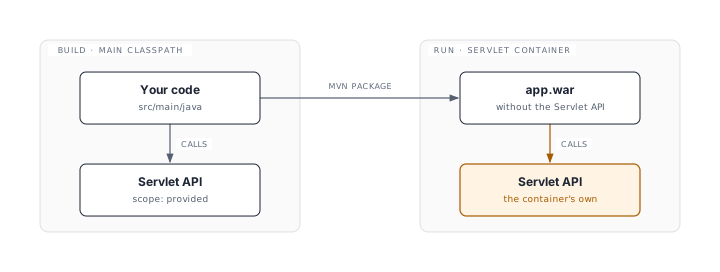
A container ships the API in the version it implements, and the Servlet specification does not let a WAR override those classes: a copy in WEB-INF/lib is dead weight at best.
runtime
For an implementation of an API that your code uses. Your code is written against the API alone, and the implementation supplies the behaviour when the program runs: a logging backend behind SLF4J, or a JDBC driver behind java.sql. The API has scope compile, the implementation scope runtime:
pom.xml
<dependency>
  <groupId>org.slf4j</groupId>
  <artifactId>slf4j-api</artifactId>
  <version>2.0.17</version>
</dependency>
<dependency>
  <groupId>ch.qos.logback</groupId>
  <artifactId>logback-classic</artifactId>
  <version>1.6.6</version>
  <scope>runtime</scope>
</dependency>
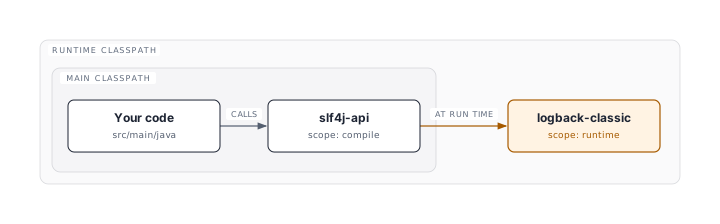
Because the implementation is not on the main classpath, your code cannot come to depend on it by accident. Code that imports a Logback class does not compile:
[ERROR] /home/me/app/src/main/java/com/example/App.java:[5,30] package ch.qos.logback.classic does not exist
That keeps the implementation replaceable: you switch to another logging backend or database driver by changing one dependency, without touching the code. A runtime dependency is passed on, so a project that depends on yours gets the implementation as well. A library should leave that choice to the application: give the implementation scope test in a library, if its tests need one at all.
test
For a library only the tests use, such as JUnit or Mockito. It is on the test classpath only, and is never passed on.
system
Like provided, but Maven does not take the file from a repository: <systemPath> gives the path of the JAR on the build machine.
pom.xml
<dependency>
  <groupId>com.example.vendor</groupId>
  <artifactId>vendor-sdk</artifactId>
  <version>4.2</version>
  <scope>system</scope>
  <systemPath>${project.basedir}/lib/vendor-sdk-4.2.jar</systemPath>
</dependency>
The path must be absolute; with a relative path the build stops with must specify an absolute path. Start it with a property such as ${project.basedir}. Maven 3 warns that a path inside the project will be unresolvable by dependent projects, and Maven 3.10 warns on every use that the system scope is deprecated.
Unlike provided, a system dependency is passed on: a project that depends on yours gets it with scope system and the same path, which has to exist on that project's machine.
The path ties the build to one machine. Install the JAR in a repository instead: Install a third-party JAR locally or deploy it to your repository manager, and give it a normal scope. For classes of the JDK itself, which older guides declared with system scope and ${java.home}/lib/rt.jar, add no dependency at all.
import
Only in <dependencyManagement>, on a dependency with <type>pom</type>: the dependency is replaced by the managed dependencies of that POM. It does not add anything to a classpath. Use a BOM, and publish one shows how it is used.
Maven 4 scopes
With model version 4.1.0, Maven 4 accepts three more scopes, which split provided and test by classpath:
| Scope | Main classpath | Test compile classpath | Test run classpath |
|---|---|---|---|
compile-only |
yes | no | no |
test-only |
no | yes | no |
test-runtime |
no | no | yes |
Only plugins built on the Maven 4 API keep to these classpaths. maven-compiler-plugin 4.0.0-beta-5 does; maven-compiler-plugin 3.16.0 and maven-surefire-plugin 3.6.1 put a dependency with one of these scopes on every classpath they build.