
Page storage internals
How Wicket stores and manages page instances internally
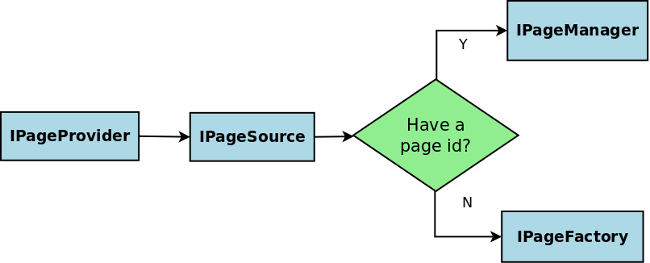
During request handling, Wicket manages page instances through interface org.apache.wicket.request.handler.IPageProvider. This interface creates a new page instance or loads a previously serialized page instance if we provide the corresponding page id. IPageProvider delegates page creation and retrieval to interface org.apache.wicket.core.request.mapper.IPageSource. When page class is provided IPageSource delegates page creation to interface org.apache.wicket.IPageFactory, while when page id is provided it uses interface org.apache.wicket.page.IPageManager to load the previously serialized page.
The following workflow diagram summarizes the mechanism seen so far:
IPageManager
org.apache.wicket.page.IPageManager’s task is to manage which pages have been used in a request and store their last state in the backing stores, namely IPageStore. The default implementation org.apache.wicket.page.PageManager uses a chain of IPageStore to collect all stateful pages which have been used in the request cycle and store them for a later use.
[!NOTE] Keep in mind that more than one page can be used in a single request if, for example, setResponsePage() or RestartResponseException are used.
As said on paragraph 8.2.4 stateful pages are stored in a session-relative file using a two-levels cache to speedup the access. This process is made possible by the different implementations of IPageStore that are part of the default chain and that will be introduced in the next paragraph.
[!NOTE] Wicket gets the default IPageManager using a supplier interface called IPageManagerProvider,hence to use a custom IPageManager implementation we must register a specific IPageManagerProvider via org.apache.wicket.Application.setPageManagerProvider(IPageManagerProvider).
Default IPageStore chain
org.apache.wicket.pageStore.IPageStore’s role is to mediate the storing and loading of page instances. The default chain of IPageStore used by Wicket contains the following ordered list of IPageStore:
-
RequestPageStore: collect all page instances involved in the last request. During the detach stage, stateful pages are passed to the other steps of the chain to be persisted on file.
-
InSessionPageStore: with InSessionPageStore the default chain keeps the last rendered page instance into the HTTP session for fast access.
-
SerializingPageStore: SerializingPageStore turns page instances into a more serialization-friendly format represented by class org.apache.wicket.pageStore.SerializedPage. This is a struct of:
{
   pageType: String,
   pageId : int,
   data : byte[]
}
i.e. this is the serialized page instance (data) plus additional information needed to be able to easily find it later (pageId, pageType).
- AsynchronousPageStore: The role of AsynchronousPageStore is to detach the http worker thread from waiting for the write of the page bytes to the disk. To disable it use: org.apache.wicket.settings.StoreSettings.setAsynchronous(false). AsynchronousPageStore can delay the storage of page’s bytes for at most org.apache.wicket.settings.StoreSettings.setAsynchronousQueueCapacity(int) pages. If this capacity is exceeded then the page’s bytes are written synchronously to the backing IPageStore.
- CryptingPageStore: page instances might contain sensible information, therefore it’s important to have the chance to encrypt their content before persist them on disk. CryptingPageStore encrypts SerializedPage’s with a 256 bit AES before passing them to the underling DiskPageStore. Buy default this stage is disabled and not added to the default chain. To change this behavior we can use org.apache.wicket.settings.StoreSettings.setEncrypted.
- DiskPageStore: stores SerializedPage on a session-scoped file on disk. The location of the folder where the files are stored is configurable via org.apache.wicket.settings.StoreSettings.setFileStoreFolder(File), by default the web container’s work folder is used (ServletContext attribute ’javax.servlet.context.tempdir’). In this folder a sub-folder is created named ’applicationName-filestore’. This folder contains a sub-folder for each active http session. This session folder contains a single file named ’data’ which contains the bytes for the pages. The size of this ’data’ file is configurable via org.apache.wicket.settings.StoreSettings.setMaxSizePerSession(Bytes). When this size is exceeded the newly stored files overwrite the oldest ones.
InMemoryPageStore
An alternative IPageStore we can use in a custom chain is org.apache.wicket.pageStore.InMemoryPageStore. This implementation stores pages in a session-relative variable which can be limited by size or by page instance number.
DebugBar
Further insights which can be valuable during debugging can be retrieved using the org.apache.wicket.devutils.debugbar.DebugBar from wicket-devutils.jar. It’s a panel which you simply add:
Java:
add(new DebugBar("debug"));
HTML:
<span wicket:id="debug"/>